For years, I’d heard (and honestly believed) that Puerto Peñasco had the second-most extreme tide in the world. I even repeated this “fact” with confident authority to anyone who would listen.
Well, it turns out I was spreading a bit of misinformation. But here’s the thing: while Rocky Point might not claim that specific silver medal, we absolutely DO have some of the most extreme tides in the world, and that’s not just local pride talking.
The Sea of Cortez, our beautiful backyard, is home to several locations with dramatically extreme tides, and Puerto Peñasco proudly sits in that exclusive club. The northern Sea of Cortez experiences tidal ranges that can reach over 24 feet (that’s more than 6 meters!). To put that in perspective, that’s taller than a two-story building. Twice a day, every single day, our sea performs this magnificent disappearing and reappearing act. Twice! Like clockwork, the water rolls in high and proud, then retreats so far, you’d swear it’s planning to leave Mexico entirely.
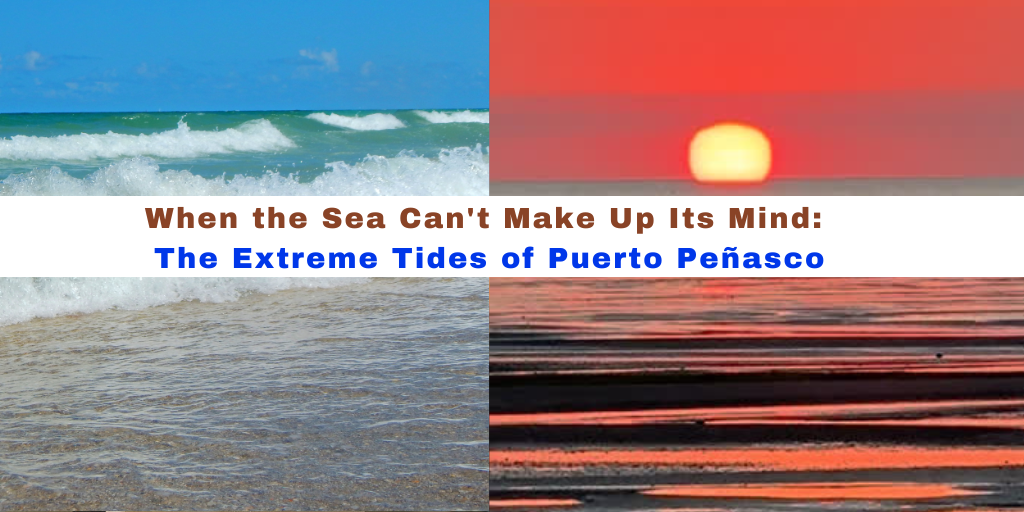
High tide in Rocky Point is breathtaking. The water rushes up to kiss the shoreline, filling tide pools, lapping at rock formations, and sometimes reaching spots you forgot could even get wet. The sea looks full, abundant, and powerful. It’s the Puerto Peñasco most first-time visitors see in photos – deep blue water stretching to the horizon, waves rolling in with authority.
But low tide? That’s when the magic really happens. The Sea of Cortez pulls back the curtain and shows you a completely different world. The water retreats so far that beaches double, sometimes triple in size. Areas that were completely underwater just hours ago are now exposed, a treasure hunter’s paradise.
When the tide goes out in Rocky Point, it leaves behind an ever-changing museum of marine life and natural art. Sand dollars scattered like forgotten coins. Shells in every shape, size, and color you can imagine – from tiny spirals to large conchs. Tide pools teeming with small fish. Starfish clinging to rocks. Seaweed creating natural sculptures. It’s like the ocean is saying, “Here, I’ll step back so you can see what I’ve been hiding.”
For beachcombers, low tide is Christmas morning. Kids splash in warm tide pools, discovering their first sea creatures up close. Photographers chase the golden hour light reflecting off the wet sand. It’s a completely different landscape – quieter, more intimate, more exploratory.
Sure, extreme tides mean you need to pay attention (parking at high tide at JJ’s Cantina in Cholla Bay, not smart…), but the positives far outweigh any inconveniences. These dramatic tides create incredibly diverse marine habitats. The intertidal zone – that area between high and low tide – becomes a rich ecosystem supporting countless species. More biodiversity means healthier oceans, and healthier oceans mean better fishing, more marine life to observe, and a more resilient coastline.
The tides also keep our beaches dynamic and ever-changing. You literally never see the same beach twice. Visit Sandy Beach at high tide, and it’s one experience. Return six hours later at low tide, and you’ve got an entirely different beach to explore. It’s like getting two vacations in one day!
For those of us who live here or visit regularly, the tides become a rhythm we sync our lives to. Planning beach walks, boat launches, fishing trips, or just deciding when to stake out your beach chair – it all revolves around consulting the tide chart. And yes, there’s an app for that! Tide charts and tide apps have become as essential to Rocky Point life as sunscreen and margaritas.
A Book About Our Moody Sea
Speaking of tides, I recently wrote a children’s book called The Sea That Wouldn’t Stay Put – because honestly, that’s the perfect description of our beautiful, restless Sea of Cortez. It’s a flip book (which I think is pretty clever if I do say so myself). Start from the front cover, and you’re reading about high tide – the full, powerful ocean in all its glory. Then flip the book over, and suddenly you’re exploring low tide and all the treasures the sea left behind for you to discover. It’s my love letter to these extreme tides and the magic they create twice daily. On Amazon or go to aksmithauthor.com.
The book reminds kids (and let’s face it, adults too) to check the tide chart, because timing is everything when you’re dealing with a sea that can’t make up its mind. Whether you’re seven or seventy, there’s something magical about working with the tides instead of against them.
So, while I can’t claim we have the second most extreme tides in the world (sorry for any confusion I may have caused over the years), I can absolutely tell you that Puerto Peñasco’s tides are extraordinary, dramatic, and one of the most fascinating features of our slice of paradise. They give us two entirely different oceans to experience every single day.
Next time you’re in Rocky Point, don’t just visit at one tide level. Check that tide chart. See the sea at high tide in all its powerful glory, then return at low tide and walk on sand that was underwater hours before. Hunt for treasures, explore tide pools, watch the sandpipers and seabirds feast on the exposed buffet. Experience both versions of our beautiful, moody, can’t-sit-still Sea of Cortez.
Because in Puerto Peñasco, the sea doesn’t just stay put – and that’s exactly why we love it.
Anita Kaltenbaugh is the author of “The Sparkling Adventures of Glowy the Fish” a children’s picture book series about the Sea of Cortez and adult suspense novels, “Her Perfect Disappearance” and “A Deep Thing” Check out all her books at aksmithauthor.com.